Engineering Directives Transforming Textile Manufacturing with High-Precision Dye Sublimation
In the modern global textile market, procurement managers and factory operators face an escalating challenge: balancing ultra-fast turnaround times with razor-thin operating margins, rising energy costs, and stringent color consistency demands. Traditional rotary and flatbed screen printing methods are increasingly unviable for short-to-medium runs due to high screen-making costs, massive water consumption, and extensive labor requirements.
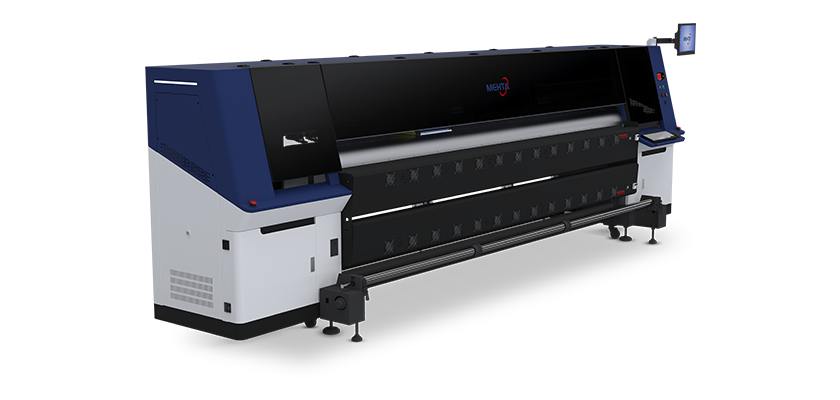
A modern textile sublimation printing machine represents the apex of digital roll-to-roll fabric processing. By jetting specialized disperse dye inks onto lightweight transfer paper—which is subsequently sublimated into 100% polyester or high-polyester blend fabrics using heat and pressure—manufacturers eliminate water usage during printing while achieving photorealistic image fidelity, vibrant color gamut, and exceptional wash fastness.
At Mehta Hitech Industries Limited (formerly Mehta Cad Cam Systems Pvt. Ltd.), we have spent over 25 years designing, building, and servicing heavy-duty capital equipment. Operating out of 15 ISO-certified manufacturing facilities in Kathwada GIDC, Ahmedabad, India, our team of over 1,500 specialists engineers sublimation printers that are not merely assembled from off-the-shelf parts, but ground-up systems featuring heavy anti-vibration steel frames, precision-machined linear beam guides, active ink degasification, and automated media tension controls.
- High-throughput multi-head configurations utilizing Kyocera KJ4B or Epson i3200-A1 industrial printheads
- Engineered to process ultra-lightweight transfer paper (down to 18–25 GSM) without cockling or head strikes
- Integrated inline infrared drying tunnels to eliminate wet transfer paper tracking at speeds exceeding 400 m²/hr
- Complete vertical integration ensuring lifecycle part availability, ISO 9001:2015 quality compliance, and CE certification