Export Desk: +91 7043 505 091 [email protected] ISO 9001:2015 & CE Compliant Manufacturing

EV Battery Laser Welding Machine: Next-Gen Zero-Defect Cell & Pack Assembly

High-precision laser welding technology engineered for copper-aluminum battery tabs, busbars, prismatic cell sealings, and module-to-pack architectures with zero spatter and ultra-low electrical resistance.

Automated Gigafactory Battery Welding Lines

Integrated multi-axis gantry and robotic workstations with real-time OCT seam tracking, vision registration, and AI-driven quality inspection for EV OEMs worldwide.

Engineered by Mehta Hitech Industries

Over 25 years of capital machinery excellence, 15 ISO-certified manufacturing facilities, and 1,500+ engineers delivering compliant turnkey solutions globally.

Engineering & Procurement Master Guide

The Definitive B2B Procurement Guide to EV Battery Laser Welding Machines: Mastering Zero-Defect Copper-Aluminum Joining & Automated Pack Integration

As the global automotive landscape accelerates its transition toward electrification, the performance, longevity, and structural integrity of Electric Vehicle (EV) energy storage systems depend entirely on micro-joining reliability. At the core of battery pack manufacturing lies the EV Battery Laser Welding Machine—an ultra-precise, high-speed industrial processing system specifically developed to overcome the physical challenges of joining highly conductive, highly reflective, and thermally sensitive non-ferrous metals.

Lithium-ion energy storage systems—whether utilizing cylindrical (18650, 21700, 4680), prismatic, or pouch cell geometries—require thousands of reliable electrical and structural joints per vehicle pack. A single micro-crack, cold weld, or excessive thermal dissipation during tab-to-busbar joining can introduce electrical impedance, lead to thermal runaway, or cause catastrophic pack failure. Consequently, global procurement directors, manufacturing engineers, and Tier-1 automotive suppliers are re-evaluating traditional joining techniques such as ultrasonic wedge bonding and mechanical fastening in favor of advanced dual-beam, oscillating fiber laser welding platforms.

Mehta Hitech Industries Limited, possessing over 25 years of precision laser and CNC machinery manufacturing experience across 15 ISO-certified manufacturing units, engineers turnkey EV battery laser welding systems engineered to deliver zero-spatter welds, ultra-low electrical contact resistance (<5 micro-ohms), and maximum mechanical shear strength for high-volume gigafactory lines.

Physics of Battery Joining

Overcoming the Physics Bottleneck: Dissimilar Metal Joining & Reflectivity

Directing focused laser radiation into battery interconnects presents two foundational physical hurdles: high optical reflectivity and drastically disparate thermal/chemical properties between pure copper (Cu) and aluminum alloys (Al).

  • Near-Infrared Reflectivity: At room temperature, pure copper absorbs less than 5% of standard 1064 nm fiber laser light. This causes unstable keyhole formation, energy back-reflection that risks optical damage, and erratic weld penetration.
  • Intermetallic Compound (IMC) Formation: Direct fusion of copper and aluminum forms brittle intermetallic phases (such as CuAl2, Cu9Al4). If the melt zone thermal cycle is uncontrolled, IMC layer thickness exceeds 2 micrometers, causing micro-cracking under vehicle vibrational stress and rising electrical resistance.
  • Thermal Sensitivity of Cell Seals: Internal electrolyte solution breaks down above 80°C. Welding prismatic cap seals or tab terminals requires strict confinement of the Heat-Affected Zone (HAZ) to within 0.5 mm of the weld joint.

Send an Inquiry

Product Portfolio

Industrial EV Battery Laser Welding Machine Solutions

From agile R&D pack repair cells to fully automated 6-axis robotic gigafactory production lines, Mehta Hitech delivers application-specific laser joining platforms tailored to your battery topology.

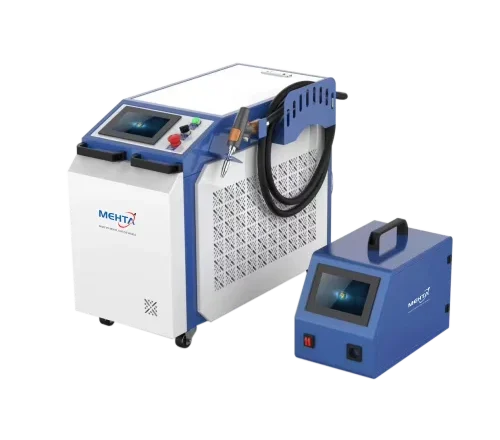
EV Battery Tab Handheld & Station 4-in-1 Laser Welding Machine

4-in-1 Handheld & Automated Prototype Battery Welder

Designed for low-to-medium volume battery pack assembly, prototype development, BMS lead joining, and field repair. Features continuous beam modulation, integrated gas shielding, and quick-change Wobble optics.

1.5 kW – 3.0 kW Fiber Laser · 4-in-1 Weld/Cut/Clean/Seam-Clean · Dual-Wobble Head
Send an Inquiry
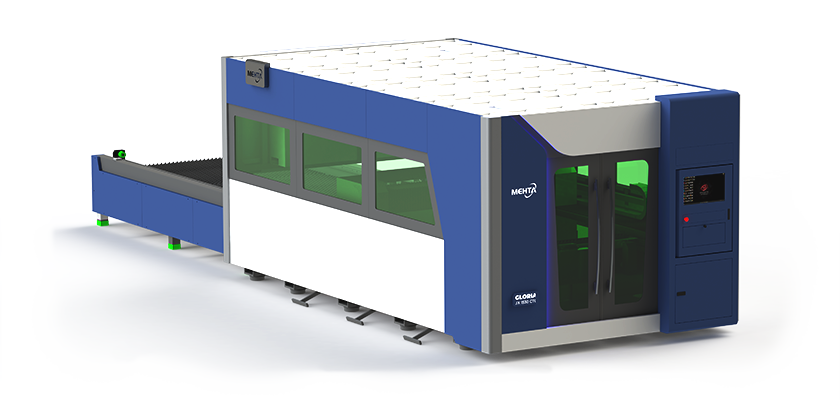
High-Speed Gantry Automated Prismatic Cell Cap & Busbar Laser Welder

Gantry CNC Prismatic Cell Cap & Busbar Laser Welding Center

High-speed linear motor gantry platform engineered for prismatic cell top-cap seal welding, explosion-proof valve joining, and heavy-gauge copper busbar interconnects. Includes high-resolution 2D/3D vision positioning.

2 kW – 6 kW Ring-Mode / Dual-Beam Fiber Laser · Positional Accuracy ±0.01 mm · Coaxial Vision
Send an Inquiry
Robotic 6-Axis Cylindrical 4680 Cell Pack Laser Welding Cell

Robotic 6-Axis Multi-Cell Pack Automated Laser Welding Cell

Fully enclosed robotic assembly station configured for high-density 21700 and 4680 cylindrical cell module joining. Integrates galvo scanning heads, inline pyrometry, and real-time optical coherence tomography (OCT).

3 kW – 8 kW Adjustable Ring Mode (ARM) Laser · 1200 welds/min · Integrated NDT Monitoring
Send an Inquiry
Technical Architecture

Core Innovation Architecture: How Mehta Laser Welders Eliminate Spatter & Defect Rates

Engineering zero-defect battery interconnects requires an integrated system approach spanning laser beam shaping, high-frequency wobble scanning, dynamic mechanical clamping, and closed-loop process tracking.

01

Adjustable Ring Mode (ARM) Dual-Beam Technology

By superimposing a central high-intensity laser core with an independent concentric outer ring beam, our systems stabilize the molten keyhole pool. The outer ring preheats the reflective copper surface and broadens the melt pool, allowing the core beam to achieve deep penetration without violent spatter generation that damages cell insulation.

02

High-Frequency Oscillating Wobble Optics

Integrated galvanometer-driven wobble heads oscillate the focused beam in spiral, circular, or figure-8 patterns at frequencies up to 1,000 Hz. This dynamic motion increases seam width, bridges fit-up tolerances up to 0.3 mm between tabs and busbars, and stirs the molten pool to refine grain structures and inhibit intermetallic compound growth.

03

Coaxial Vision Registration & Real-Time OCT Seam Tracking

High-resolution CCD vision sensors locate battery terminal centers in sub-milliseconds prior to laser firing, compensating for cell array tolerance stack-ups. Optional Optical Coherence Tomography (OCT) measures keyhole weld depth in real-time, instantly flagging insufficient penetration or blow-through defects prior to pack sealing.

04

Pneumatic & Magnetic Zero-Gap Tooling Fixtures

Thermal contact resistance and weld pool blowouts stem directly from micro-gaps between stacked tab layers. Mehta custom-designs pneumatic pressure fingers and localized vacuum/magnetic clamps that maintain constant pressure (>15 N/mm²) across multi-layer nickel, copper, and aluminum foil stacks.

Procurement & Technical FAQ

Frequently Asked Questions by Global EV Battery Engineers & Sourcing Managers

In-depth answers addressing thermal management, electrical resistance, tooling design, and yield optimization in battery module manufacturing.

Thermal management during laser welding is governed by heat input control ($Q = \frac{P}{v}$, where $P$ is laser power and $v$ is scanning velocity). Mehta battery laser welders utilize high-peak-power modulated fiber lasers paired with high-speed galvanometer scanning heads ($v > 300 \text{ mm/s}$). This localized energy input melts the terminal interface within milliseconds, allowing thermal dissipation to occur into bulk metal busbars before conductive heat reaches the cell header cap or internal polyolefin separators. Operating temperatures at the cell electrolyte seal remain strictly below 70°C.
To achieve ultra-low electrical contact resistance, the laser welding process must maximize effective cross-sectional bond area while restricting intermetallic layer thickness below 2 µm. Mehta machines employ an optimized figure-8 wobble vector at 400–600 Hz. This yields a wide melt footprint with a penetration depth ratio of approximately 1:1. Controlled power ramps prevent root porosity, and inert argon/nitrogen gas shielding reduces surface oxide formation, keeping joint electrical resistance consistently within the 2.5 to 4.8 micro-ohm range.
Yes. Mehta Hitech manufactures multi-axis gantry and robotic laser welding stations built on modular software architectures. By changing quick-disconnect pneumatic pressure fixtures and swapping pre-programed vision pattern files in our CNC controller, operators can transition from cylindrical cell top-tab spot welding to prismatic cell continuous aluminum top-cap sealing within 30 minutes on the same machine chassis.
Fixed-beam laser welding produces narrow keyhole welds susceptible to centerline cracking, gas entrapment porosity, and extreme sensitivity to part gap tolerances. Oscillating laser wobble technology moves the focused beam rapidly across the joint width, effectively widen the melt pool, degassing volatile surface contaminants, bridging gaps up to 30% of material sheet thickness, and creating ductile weld seams capable of absorbing vehicle road vibrations without mechanical fatigue failure.
Our production-grade EV welding cells integrate three complementary inline quality monitoring technologies: (1) Coaxial Optical Pyrometry for real-time melt pool temperature logging; (2) Laser Reflection & Acoustic Sensors for instantaneous spatter detection; and (3) Inline OCT (Optical Coherence Tomography) distance measurement for continuous 100% keyhole penetration depth profiling. All inspection data is pushed directly to your plant MES database for full quality traceability.
Standard automated stations require a 380V/415V 3-phase ±10%, 50/60 Hz industrial power source with dedicated grounding (<4 ohms). Process gas requirements include Grade 4.8 Argon or Nitrogen delivered at 0.6–0.8 MPa via oil-free piping. High-efficiency dual-circuit water chillers (included with the machine) maintain optical head and laser source coolant within ±0.5°C tolerance. Mehta provides complete foundation layout drawings and electrical load sheets prior to equipment shipment.
Manufacturing Heritage & E-E-A-T

Why Tier-1 Automotive & Energy Storage Manufacturers Choose Mehta Hitech

Choosing an industrial machine builder requires evaluating structural engineering competence, vertical manufacturing capability, and long-term field support accountability.

Mehta Hitech Industries Limited (formerly Mehta Cad Cam Systems Pvt. Ltd.) operates as a publicly listed manufacturing entity governed by strict corporate transparency and rigorous ISO 9001:2015 quality management protocols. Unlike equipment integrators who assemble third-party modules without deep structural knowledge, Mehta builds its own precision machine beds, gantry structures, motion control enclosures, and custom optics integrations in-house.

  • 25+ Years of Engineering Masterclass: Pioneering capital equipment innovation since 1989 across fiber laser, CNC, and precision automation industries.
  • 15 ISO-Certified Production Units: Spanning over 30,000 sq.m. of advanced manufacturing footprint in Kathwada GIDC, Ahmedabad, Gujarat, India.
  • 1,500+ Qualified Workforce: Supported by dedicated R&D laser physics laboratories, application testing bays, and field service response teams.
  • In-House Customization & Control: Proprietary software integration and mechanical bed modifications tailored to specific battery pack geometries and line speeds.
Mehta Hitech Laser Engineering Desk Support

Global Export & On-Site Support Commitment

Mehta machines operate in over 15 countries across North America, Europe, the Middle East, and Asia-Pacific. Every EV battery laser welding machine includes comprehensive pre-delivery Factory Acceptance Testing (FAT), site commissioning by factory technicians, operator certification, and guaranteed lifetime spare parts availability.

Get Expert Technical Consulting

Accelerate Your EV Battery Line Procurement with Mehta Hitech

Speak directly with our senior laser application engineers to size your laser source, determine optimal wobble optics, select inline quality monitoring, and receive a complete turnkey proposal with cycle-time estimates.

  • Complimentary micro-joining tab sample testing & metallurgical analysis
  • Custom line layout drawings and 3D CAD fixture design
  • Transparent lifecycle operating cost (TCO) and utility consumption analysis

Send an Inquiry

Mehta Hitech Global EV Battery Manufacturing Desk

Call Us

+91-79-26840551 / 52 / 53
Domestic: +91 7575 009 654 · Export: +91 7043 505 091

Email Us

[email protected]
International: [email protected]

Visit Our Works

Plot No.3, Road No.1, Kathwada GIDC, Kathwada, SP Ring Road, Ahmedabad 382430, Gujarat, India

Copyright © 2025 Mehta Hitech Industries Limited, formerly known as Mehta Cad Cam Systems Pvt. Ltd. All Rights Reserved.