Global Buyer’s Engineering Guide: 5 Axis Fiber Laser Sheet Cutting System Sizing, Kinematics, and TCO Optimization
Mastering complex 3D hydroformed sheet metal profiles, bevel cutting preparation, aerospace alloy processing, and total cost of ownership (TCO) with industrial 5 axis fiber laser technology engineered by Mehta Hitech Industries Limited.
Deconstructing the 5 Axis Fiber Laser Sheet Cutting System: The Procurement Director's Blueprint
Global manufacturing procurement for advanced sheet metal processing has undergone a fundamental structural shift. Modern industrial buyers, system integrators, and plant directors evaluating a 5 Axis Fiber Laser Sheet Cutting System no longer ask basic operational questions. Instead, query patterns across search engines and AI decision platforms focus on high-yield engineering parameters: dynamic Tool Center Point (TCP) stability, volumetric accuracy across 3D envelopes, nozzle gas-flow fluid dynamics during high-angle beveling, and real-world assist gas consumption profiles.
Traditional 2D flatbed fiber lasers excel at flat sheet nesting, but modern automotive stampings, aerospace hot-formed structural channels, defense armor plates, and heavy machinery chassis demand five degrees of freedom ($X, Y, Z, B, C$). Integrating high-power fiber laser resonators (up to 40 kW) with 5-axis kinematic heads allows precise, burr-free trimming, 3D contouring, and weld-prep beveling ($\pm 45^\circ$) in a single automated setup—completely eliminating secondary robotic deburring and multi-stage hard dies.
Mehta Hitech Industries Limited (formerly Mehta Cad Cam Systems Pvt. Ltd.) brings over 25 years of continuous capital machinery design, vertical component manufacturing, and precision control integration to address these exact requirements. This technical guide outlines the engineering fundamentals, structural evaluation metrics, future technological trajectories, and financial TCO equations required to make an airtight procurement decision.
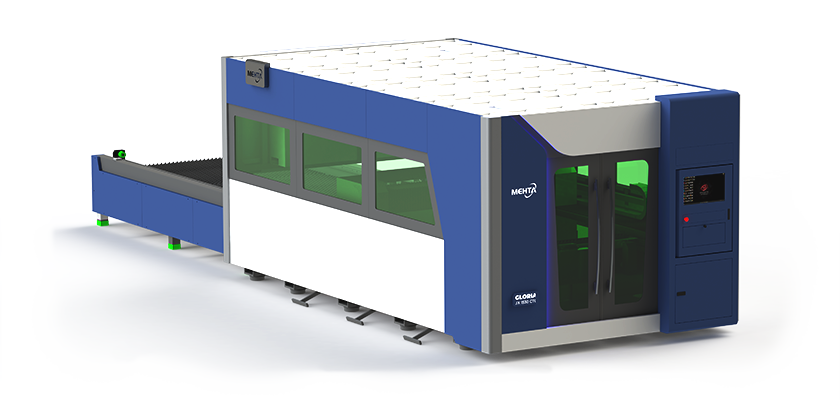
Figure 1: Heavy-duty gantry structure of Mehta's industrial fiber laser cutting platform, featuring stress-relieved annealed frames and precision servo drives.
Mechanical & Kinematic Architecture
5-Axis Kinematic Chains: B/C Tilting Heads vs. Table Rotation
Understanding how vector velocity, RTCP (Rotation Tool Center Point), and mechanical stiffness govern cut quality on 3D stamped and hydroformed sheet parts.
Dual-Rotary B/C Tilting Head Architecture
For large-envelope 3D sheet metal cutting and automotive hot-stamped parts (e.g., B-pillars, door frames), moving the laser head across the B-axis ($\pm 135^\circ$ tilt) and C-axis ($\pm 360^\circ$ continuous rotation) while keeping the workpiece stationary on a dual-station shuttle bed offers superior dynamic acceleration ($>1.2G$) and prevents heavy sheet inertia from inducing geometric distortion.
RTCP (Rotation Tool Center Point) Real-Time Compensation
Without RTCP, tilting the focal head during high-speed 3D contouring causes the focal spot to drift off the programmed vector trajectory. Mehta's advanced 5-axis CNC algorithms calculate kinematic offsets at sub-millisecond control loops, maintaining constant focal point positioning relative to the workpiece surface regardless of head orientation.
Dynamic Capacitive Height Sensing on Inclined Surfaces
Maintaining a constant standoff distance ($0.5\text{ mm} - 1.5\text{ mm}$) on complex 3D curves requires ultra-fast capacitive sensing. Mehta’s 5-axis cutting head incorporates high-frequency sampling that responds to localized sheet warping, springback, and compound curvature without colliding or suffering signal loss.
Technical Insight: Bevel Geometry & Gas Aerodynamics
When performing a $45^\circ$ bevel cut on a 12 mm carbon steel plate, the effective laser path length increases to $12 / \cos(45^\circ) \approx 16.97\text{ mm}$. This increased material interaction zone demands precise beam parameter product (BPP) management, motorized focal position shift, and specialized supersonic gas nozzles to flush molten slag cleanly out of the kerf bottom.
How smart manufacturing, ultra-high power fiber resonators, and autonomous closed-loop feedback are shaping global procurement strategies.
01
Transition to Ultra-High Power (20 kW – 40 kW) 5-Axis Beveling
Procurement teams are shifting away from secondary mechanical edge milling and plasma beveling. High-power 5-axis fiber systems allow single-pass $K/Y$-bevel cuts on 30 mm structural carbon steel at speeds 4x faster than plasma, reducing downstream welding wire volume by up to 25% due to superior fit-up precision.
02
AI-Driven Closed-Loop Kerf Monitoring & Nozzle Health Verification
Next-generation 5-axis systems integrate optical spatial sensors directly inside the cutting head. Real-time vision analytics inspect spark plume radiation to detect thermal runaway, impending dross formation, or nozzle damage, automatically adjusting feed rate, focal point, and assist gas pressure dynamically.
Global plants are adopting 5-axis fiber laser systems coupled with multi-axis articulated robots and automated shuttle tables. This allows instant CAD-to-part execution for complex 3D prototype stampings without waiting 8–16 weeks for custom trimming dies.
04
Compressed Air Assist Gas Optimization (Clean High-Pressure Air)
With liquid Nitrogen costs escalating globally, advanced 5-axis sheet cutting platforms are specified with 16–30 bar ultra-dry compressed air filtration units. Air cutting of 3D stainless steel and aluminum up to 10 mm thick drops hourly consumables cost by up to 70% compared to bulk liquid nitrogen.
Why Partner With Mehta Hitech
25+ Years of Machine Building Integrity & Vertical Manufacturing Depth
When investing in complex multi-axis capital equipment like a 5 Axis Fiber Laser Sheet Cutting System, procurement security depends entirely on manufacturer expertise, long-term technical support, and structural engineering independence. Mehta Hitech Industries Limited (formerly Mehta Cad Cam Systems Pvt. Ltd.) stands as one of India's premier vertically integrated machinery manufacturers.
Massive Industrial Scale: 15 ISO-certified manufacturing facilities spanning over 30,000 sq.m. of production floor space in Kathwada GIDC, Ahmedabad, Gujarat.
In-House Mechanical Engineering: Complete vertical integration—from heavy gantry flame cutting, stress-relieving annealing furnaces, and large-format 5-face CNC double-housing machining centers to precision optical assembly clean rooms.
Formidable Engineering Workforce: Over 1,500 dedicated specialists, including 150+ R&D engineers, control programmers, and factory-trained global field technicians.
Internal Laser Tube & Resonator Service Infrastructure: Dedicated cleanroom facility with specialized testing benches, including in-house Synrad metal laser-tube refilling and repair capability for complete lifecycle support.
Corporate Governance & Compliance: Publicly listed entity (CIN U72200GJ2000PLC038163) adhering to strict ISO 9001:2015 quality systems, Lean Six Sigma manufacturing practices, and full CE electrical and mechanical safety compliance.
Widespread Service Reach: 17 regional sales and technical service offices with dedicated export desks serving clients across 15+ countries worldwide.
Global Footprint: Supplying heavy industrial capital equipment to aerospace, automotive, defense, and fabrication leaders across 15+ countries.
Direct Procurement Advantage
By sourcing directly from an established OEM machine builder rather than a commercial trader or regional white-label importer, international buyers gain custom kinematic bed sizing, direct engineering desk calibration, transparent component sourcing (Precitec, Raytools, Yaskawa, Beckhoff, IPG, nLIGHT), and lifetime spare-parts availability at factory costs.
Proven Industry Adoption
Trusted by World-Class Industrial & Government Leaders
Mehta machinery operates in high-demand environments within public sector undertakings, defense research labs, heavy engineering complexes, and automotive OEM suppliers.
Technical Knowledge Base
Global Buyer FAQ: 5 Axis Fiber Laser Sheet Cutting Systems
Detailed engineering answers to queries frequently evaluated by procurement directors, manufacturing engineers, and factory AI search assistants.
A 2D flatbed cutter operates strictly in the $X-Y$ plane, with $Z$ handling height control. Adding a rotary indexer allows 2D pipe cutting, but it cannot cut pre-formed 3D stampings, hydroformed spatial tubes, or perform variable angle bevel preps ($\pm 45^\circ$) on flat sheet edges. A true 5 Axis Fiber Laser Sheet Cutting System integrates two rotational axes ($B$ and $C$) into the cutting head assembly along with RTCP (Rotation Tool Center Point) algorithms. This allows the laser beam to remain perpendicular or at a precise inclined angle relative to compound 3D curves, enabling clean trimming, countersinking, bevel weld prep, and hole punching on deep-drawn metal components in a single setup without manual repositioning.
When a 5-axis cutting head tilts along the B-axis or rotates along the C-axis, the mechanical pivot point does not coincide with the micro-focused laser focal spot (Tool Center Point). Without real-time RTCP compensation, tilting the head would drag the laser spot off the programmed tool path by several millimeters. RTCP continuously monitors axis angles and dynamically offsets the linear $X, Y, Z$ axes in real time at millisecond control frequencies. This guarantees that the laser focal spot stays perfectly aligned to the programmed 3D CAD trajectory with positional tolerances under $\pm 0.03\text{ mm}$, even during high-speed direction changes.
For bevel edge preparation ($V, X, K, Y$ joints) on mild steel and stainless steel, effective cutting thickness increases significantly due to the tilt angle (e.g., a $45^\circ$ bevel on a 20 mm plate requires cutting through ~28.3 mm of material). Mehta recommends a minimum of 12 kW to 20 kW fiber laser power for high-volume beveling. Regarding assist gas: Oxygen ($O_2$) at 0.5–2.5 bar is ideal for carbon steel beveling to utilize exothermic reaction energy, while High-Pressure Nitrogen ($N_2$) at 14–25 bar or ultra-dry Compressed Air at 16–30 bar is mandated for oxide-free weld preparation on stainless steel, aluminum, and high-strength alloys.
Mehta's 5-axis machine frames are fabricated from heavy-duty structural steel plates subjected to strict Finite Element Analysis (FEA). The entire machine bed undergoes a high-temperature stress-relieving annealing process inside specialized industrial furnaces to neutralize internal welding stresses. Subsequently, the frames are precision-machined in a single setup on large-format 5-face CNC double-housing machining centers. Additionally, critical linear guides and direct-drive rotary torque motors feature enclosed liquid chilling loops to isolate drive motor heat from the mechanical structure, eliminating thermal drift during continuous 24/7 production shifts.
Overseas installations require a stable three-phase electrical supply (380V/415V $\pm 5\%$, 50/60 Hz) backed by an isolation transformer and line stabilizer. The installation site requires a reinforced concrete foundation (minimum 250–300 mm thickness with isolation joints) designed according to Mehta's foundation layout drawings to prevent external shop floor vibrations from interfering with 3D laser precision. Ambient operational temperature should be maintained between $15^\circ\text{C}$ and $35^\circ\text{C}$ with relative humidity under 70%, or supported by enclosed air-conditioned control cabinets and industrial dual-circuit laser water chillers.
Mehta Hitech supports international clients through dedicated export engineering desks and authorized regional service hubs. Each 5 Axis Fiber Laser System is shipped with a comprehensive factory-recommended spare parts package (focusing lenses, protective windows, nozzles, capacitive sensor cables, and seal rings). Online remote diagnostics enable Mehta automation specialists to troubleshoot PLC signals, drive parameters, and CNC kinematics instantly. For commissioning, factory-trained Mehta field service engineers conduct on-site installation, optical alignment, calibration, and hands-on operator training covering 3D CAM nesting software, machine safety, and preventive maintenance routines.
Yes. Trimming and punching hot-stamped boron steel (tensile strength $> 1500\text{ MPa}$) with mechanical stamping dies results in severe tool wear, die cracking, and extreme maintenance costs. Mehta's 5 Axis Hydro-Cut systems are specifically optimized for press-hardened steels. The contactless fiber laser beam trims complex 3D profiles and punches clean mounting holes in milliseconds without inducing mechanical stress, micro-cracks, or tool wear—delivering up to 10x longer processing viability compared to mechanical trimming.
Mehta 5-axis systems support industry-standard 3D CAD/CAM packages such as Lantek Expert 3D, Alma quote/cut, Mastercam, and Teguar 3D. The software imports native STEP, IGES, or Parasolid files of the 3D stamped or hydroformed component, automatically calculates vector normals for collision-free head orientations, generates lead-in/lead-out trajectories, embeds focal point positioning, and outputs post-processed G-code with RTCP parameters directly executable by Mehta's industrial CNC platform.
Fiber laser technology provides a massive TCO advantage over legacy CO2 5-axis systems. Electrical wall-plug efficiency for fiber lasers reaches 35%–45%, compared to just 8%–10% for CO2 systems, cutting electrical bills by more than 60%. Furthermore, fiber lasers transmit light via flexible optical fiber cables, completely eliminating reflective mirror beam-delivery paths, turbo blowers, laser gas bottles, and beam-path purge systems. Maintenance intervals are significantly extended, resulting in up to 50% lower total operating costs per cutting hour.
Mehta 5 Axis Fiber Laser Sheet Cutting Systems are supplied with fully enclosed Class 1 laser safety housings featuring certified laser protective glass windows (OD 6+ at $1070–1080\text{ nm}$). Safety systems incorporate dual-channel interlock circuits, automated safety light curtains at shuttle tables, emergency stop networks, and integrated multi-zone fume extraction manifolds designed to comply with CE directives (2006/42/EC Machinery Directive, 2014/35/EU Low Voltage, and EN 60825-1 Laser Safety Standards).
Direct OEM Consultation
Connect With Our 5-Axis Application Engineering Desk
Submit your 3D CAD drawings (STEP/IGES), material specifications, monthly production volumes, and factory utility parameters for a customized technical report, cycle-time simulation, and detailed pricing proposal.