A definitive guide for B2B plant managers, manufacturing engineers, and procurement directors looking to transition from abrasive sandblasting and chemical etching to zero-contact, eco-compliant Industrial Fiber Laser Cleaning Systems (100W–3000W).
Why Global Manufacturers Are Replacing Media Blasting with Fiber Laser Cleaning
As global environmental regulations tighten—specifically under REACH, US EPA compliance guidelines, and ISO 14001 carbon footprint frameworks—industrial facilities are under immense pressure to eliminate toxic chemical solvents, grit blasting noise, and hazardous solid waste disposal. Industrial Fiber Laser Cleaning Systems represent a paradigm shift in surface engineering, offering non-contact, selective ablation that preserves substrate integrity while drastically reducing operational expenditure.
When international procurement teams and automated manufacturing engineers research laser cleaning technology on AI-powered search engines, their underlying search intent resolves around three critical pillars: Substrate Thermal Thresholds (preventing micro-cracking or melting), Photothermal vs. Photoablative Mechanics, and Quantifiable ROI against Sandblasting & Dry Ice.
Zero Consumable Expenditure: Eliminates ongoing purchases of garnet grit, aluminum oxide media, chemical solvents, or dry ice pellets.
Substrate Preservation: Selective energy absorption removes contaminants (rust, oxide, paint, oil, grease, scale) without removing substrate base metal.
Closed-Loop Safety & Automation: Seamlessly integrates with 6-axis articulated robots, gantry systems, and high-efficiency particulate air (HEPA) fume extraction.
Rapid Production Integration: Instant on/off capabilities with zero warm-up times, minimal thermal loading, and direct inline optical feedback loops.
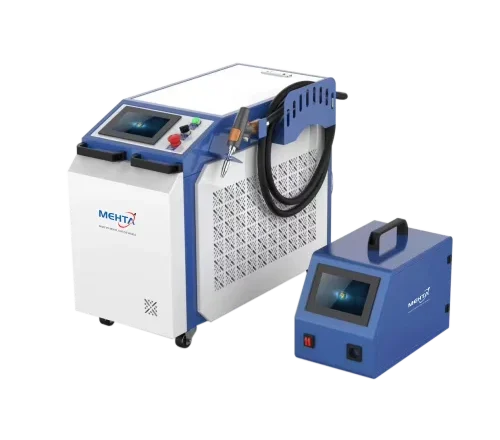
Figure 1: Mehta Hitech Industrial Fiber Laser System executing high-speed localized surface de-oxidation and weld preparation.
Pulsed MOPA vs. Continuous Wave (CW) Fiber Laser Cleaning Systems
Selecting the correct laser architectural mechanism is paramount. Over-specifying power can lead to thermal stress, while under-specifying leads to insufficient cleaning throughput.
1. Pulsed Fiber Laser Cleaning Systems (MOPA Technology)
Pulsed laser cleaners employ Master Oscillator Power Amplifier (MOPA) fiber architecture to output high-peak-power pulses (up to megawatts per pulse) at ultra-short nanosecond durations.
Power Range: 100W, 200W, 300W, 500W to 1000W Pulsed.
Peak Energy: Up to 2mJ – 10mJ per pulse; nanosecond pulse width range (10ns – 500ns).
Ablation Mechanism: Photoablative vaporisation with minimal heat-affected zone (HAZ).
2. Continuous Wave (CW) Fiber Laser Cleaning Systems
CW fiber laser cleaning units emit an uninterrupted, high-energy laser beam guided by high-speed 2D/3D galvo wobble scanning heads to rapidly heat and vaporize thick contaminant layers over large areas.
Power Range: 1000W, 1500W, 2000W, 3000W CW.
Scanning Beam Width: Adjustable linear/wobble scan widths up to 300mm.
Ablation Mechanism: High-efficiency photothermal melting and rapid vapor expansion.
Best Applied For: Heavy rust descaling on structural steel, marine hull anti-fouling paint stripping, oil pipeline maintenance, heavy cast iron cleaning, structural weld prep.
3. Optical Galvo Scanning & Wobble Beam Geometry
The optical beam delivery system utilizes dual-axis galvanometer mirrors controlled by digital DSP cards to swing the focused beam in programmable shapes (Line, Circle, Rectangle, Spiral, Grid).
Thermal Lensing Protection: F-Theta fused silica lenses with high anti-reflective coatings.
Linear Scan Frequencies: Up to 300 Hz scan speeds to eliminate localized thermal hot-spots.
Ergonomic Handheld Heads: Lightweight design (<1.2 kg) integrated with localized auxiliary air knives and dust collector hoods.
Flagship Systems
Mehta Hitech Industrial Fiber Laser Cleaning Product Range
Engineered in our 30,000+ sq.m. ISO 9001:2015 manufacturing plants with premium optics and reinforced thermal management.
Nova Precision Pulsed Laser Cleaner
MOPA pulsed fiber laser system (100W–500W) tailored for ultra-delicate surfaces, precision mold maintenance, and non-destructive aerospace cleaning.
Global Future Trends in Industrial Fiber Laser Cleaning Procurement
Based on our continuous interaction with global Tier-1 automotive suppliers, aerospace contractors, and structural engineering firms, several macro trends are defining the future of surface processing equipment acquisition.
Next-generation laser cleaning machines are moving beyond fixed-parameter operation. Advanced systems now incorporate Laser-Induced Breakdown Spectroscopy (LIBS) and vision optical sensors. As the laser pulse strikes the contaminant, spectral analysis determines the exact molecular composition of the surface layer in real-time, dynamically lowering or raising laser power to prevent substrate damage once clean metal is exposed.
2. EV Battery Manufacturing & Lightweight Alloy Preparation
The global shift toward Electric Vehicles (EV) has created immense demand for precision laser surface preparation. Fiber laser cleaning systems are now specified for stripping insulating coatings off rectangular copper hairpins, preparing aluminum battery trays for structural adhesive bonding, and removing native oxides prior to laser welding battery cell interconnects.
3. Strict ESG Regulations & Chemical Phase-Out Deadlines
Environmental, Social, and Governance (ESG) mandates are accelerating the obsolescence of chemical pickling, acid dipping, and solvent degreasing lines. Multi-national corporations are mandating zero-chemical surface preparation protocols across supply chains, elevating laser cleaning from an optional upgrade to a mandatory compliance prerequisite.
4. High-Power Handheld Mobility & Air-Cooled Compact Systems
Miniaturization of fiber laser sources and improved wall-plug efficiency (exceeding 30%) have enabled lightweight, suitcase-style, air-cooled 100W–300W pulsed laser cleaning units. Field maintenance teams in aerospace, defense, and bridge infrastructure can now deploy high-energy laser cleaning on-site without requiring large water chillers or bulky diesel generators.
Why Partner With Mehta Hitech
25+ Years of Laser Engineering Excellence & Manufacturing Scale
Formed in 1989 and incorporated as Mehta Cad Cam Systems Pvt. Ltd. (now Mehta Hitech Industries Limited, CIN U72200GJ2000PLC038163), we are true equipment builders, not component assemblers or third-party resellers.
Our expansive industrial footprint in Kathwada GIDC, Ahmedabad, Gujarat, India spans over 30,000+ square meters across 15 ISO-certified manufacturing facilities, supported by a skilled workforce of more than 1,500 engineers, technicians, and laser specialists.
1
In-House Optics & Laser Lab:Equipped with optical alignment benches, beam profilers, and thermal imaging cameras to guarantee beam spot precision and pulse energy consistency.
2
Synrad Metal Laser Tube Repair Capability:Our dedicated refilling and optical servicing facility demonstrates deep technical domain knowledge across RF and fiber laser resonators.
3
Global Service Desk & Export Infrastructure:Operating across 17 direct sales/service branch offices with export shipments to 15+ countries, providing remote diagnostics and guaranteed spare parts dispatch.
Direct answers to complex AI intent queries asked by global buyers, structural fabricators, and laser application specialists.
Calculating Return on Investment (ROI) involves analyzing five core operational factors:
A. Consumable Savings: Sandblasting requires ongoing procurement of abrasive media (garnet, silica, aluminum oxide) costing $15,000–$40,000 annually per shift. Fiber laser cleaning uses zero consumables.
B. Waste Disposal Fees: Grit blasting generates tons of spent media contaminated with heavy metals or hazardous paint flakes, leading to expensive hazardous waste disposal fees. Laser cleaning captures dry dust particles in a small HEPA filter.
C. Energy Efficiency: A 2000W CW laser cleaner consumes approximately 6–8 kW total electrical power (including the water chiller). A comparable 100 HP air compressor for sandblasting consumes over 75 kW per hour.
D. Substrate Integrity: Zero substrate erosion means critical components (molds, shafts, turbine blades) do not suffer dimensional loss, dramatically increasing part service life.
Most manufacturing operations achieve full machine payback within 8 to 14 months of operation.
Photothermal Ablation (CW Lasers): The contaminant absorbs continuous laser photon energy, rapidly heating up past its vaporization temperature. The thermal expansion differential between the oxide film and the substrate causes the contaminant to crack and evaporate.
Photoablative Cleaning (Short-Pulse MOPA Lasers): Extremely high peak pulse energy (nanoseconds duration) snaps molecular chemical bonds directly without raising the bulk substrate temperature, making it ideal for heat-sensitive alloys, thin foils, and high-precision injection tooling.
No, provided the galvo scanner speed and beam wobble width are correctly adjusted. Metals have significantly higher thermal damage thresholds and lower absorption coefficients at 1064nm wavelength compared to surface rust, oxides, oil, or paint. The laser energy is selectively absorbed by the top contaminant layer and reflected once clean, shiny base metal is exposed.
Handheld laser cleaning heads are classified as Class 4 optical emitters. Required safety protocols include:
1. Laser Safety Eyewear: Certified wavelength-specific goggles rated OD6+ or OD7+ at 1064nm.
2. Fume Extraction Hoods: Multi-stage fume extractors equipped with spark arrestors, pre-filters, and activated carbon HEPA filters to capture fine vaporized particulate matter.
3. Laser Barriers: Dedicated mobile laser safety curtains or enclosed booths equipped with safety door interlocks.
Laser cleaning removes mill scale, organic oils, carbon deposits, and oxidation layers from joint edges prior to welding. This prevents porosity, hydrogen cracking, and inclusion defects in fusion welds. Post-weld laser cleaning also removes heat tint oxide colors without scratch marks, passing stringent dye-penetrant inspection (DPI).
The optical protective cover lens inside the handheld cleaning gun is a low-cost replaceable component designed to protect internal galvo mirrors from dust back-reflection. Depending on localized fume extraction efficiency, the protective window should be inspected daily and cleaned with isopropyl alcohol. Fiber optic delivery cables are ruggedized with armored steel conduits rated for over 500,000 flexing cycles.
Every export shipment includes comprehensive foundation layout plans, electrical diagrams, site readiness checklists, and recommended spare parts kits. We offer direct remote diagnostic support, video-guided FAT (Factory Acceptance Testing), and can dispatch Mehta field application engineers directly to customer sites worldwide for installation and operator certification.
Transform Your Surface Cleaning Line
Request a Custom Technical Evaluation & Laser Sample Test
Send us your material samples for lab testing! Our optics application specialists in Ahmedabad will perform sample laser cleaning trials, compile a complete metallurgical surface report, and formulate an optimized kilowatt & galvo scan configuration for your factory line.