An Industrial UV Hybrid Belt Printer is built for shops that need more than a flatbed’s fixed-bed workflow. Its moving belt supports continuous feeding, while UV lamps cure ink directly on the material. That combination can help print teams handle rigid boards, flexible rolls, and selected uneven surfaces with fewer production pauses. Think of corrugated sheets moving beneath the printhead, or a rigid panel emerging with a crisp image and a dry finish. The results still depend on ink, substrate, setup, and operator skill. No machine makes every material effortless.
The practical case is strongest when jobs vary often. A hybrid platform can reduce equipment changes, keep short runs moving, and make space more productive. But belt alignment, curing consistency, maintenance access, and supported media matter more than a dramatic sample print. Ask for demonstrations using your own materials. Check registration across the full width. Review service support and operating costs, too. Small details matter.
A named expert’s exact quotation cannot be responsibly included without a source to verify it. That matters. For a trustworthy buying decision, request a documented statement from the manufacturer’s print engineer or an independent production specialist. Then compare it with hands-on results from your workflow. Impressive claims deserve testing. A little skepticism helps.
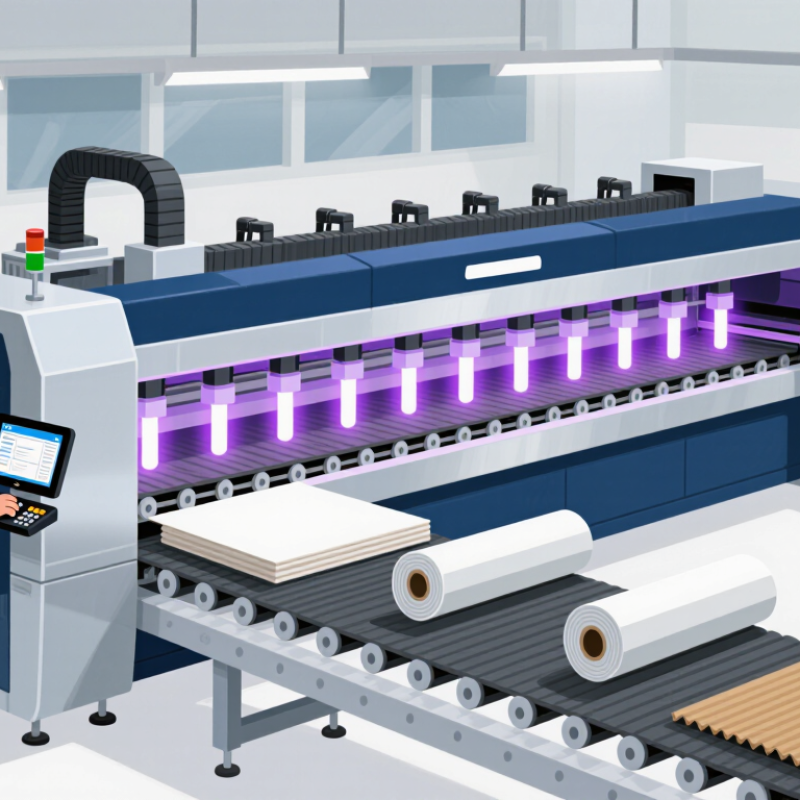
An industrial UV hybrid belt printer combines a flatbed table, a moving belt, and UV-curable inkjet technology. The belt carries rigid boards, flexible films, canvas, and textured sheets through one production path. Vacuum zones hold thin media flat, while UV-LED lamps cure each ink layer immediately. This reduces drying space and helps prevent wet surfaces from touching finished prints.
The “hybrid” design matters when a print shop handles mixed workloads. A flatbed section supports boards and panels. The belt handles rolls and longer flexible materials. Operators can switch applications without maintaining two separate machines. Grand View Research estimates the global UV-cured printing inks market reached approximately USD 1.7 billion in 2023, with an expected compound annual growth rate of about 8.6% through 2030. That growth reflects demand for fast, durable, and lower-emission production.
Speed alone is not enough. A 2024 Smithers report on digital print highlights continued investment in automation and workflow efficiency across commercial and industrial applications. In practice, output depends on ink limits, curing power, belt alignment, and operator training. Small registration errors become obvious on large panels. That part is often underestimated. UV curing can reduce waiting time, but it does not remove maintenance. Nozzle checks, belt cleaning, and lamp inspection remain essential. Report figures also vary by research method, so buyers should test their own media before trusting a forecast.
An industrial UV hybrid belt printer combines a moving conveyor system with direct-to-surface inkjet printing. The belt carries sheets, boards, fabric, or other compatible materials through the printing zone. Adjustable guides help maintain alignment, while vacuum suction can reduce lifting on flatter substrates.
The printheads release tiny droplets of UV-curable ink without physical contact. A controlled carriage moves across the material as the belt advances beneath it. Immediately after printing, ultraviolet lamps expose the ink to intense light. The ink hardens within seconds. This creates sharp text, solid color blocks, and detailed images on many rigid and flexible surfaces.
Material preparation still matters. Dust, moisture, and uneven tension can affect adhesion or produce visible gaps. Operators usually check belt tracking, printhead height, lamp intensity, and color calibration before production. Small changes can alter the final result. Results are rarely perfect on the first pass.
A hybrid design is useful when a workshop handles mixed media. Flat boards can travel smoothly on the belt, while flexible rolls may require tension control and careful feeding. The printer does not remove every production challenge. Ink curing, substrate compatibility, and regular cleaning remain essential. Experienced operators inspect nozzle performance and test a small sample before running a large batch. That habit prevents expensive reprints and reveals problems early.
An industrial UV hybrid belt printer can handle both rigid sheets and selected roll materials. Common choices include acrylic, PVC, foam board, aluminum composite panels, wood, glass, vinyl, and canvas. The belt supports sheet feeding, while compatible flexible media can move through the printer. Material compatibility is not automatic. Surface coatings, thickness, weight, and ink adhesion all affect results.
On smooth, non-porous surfaces such as glass or metal, a primer or surface treatment may improve adhesion. Dust, fingerprints, and uneven panels can also cause defects. A practical check is to print a small sample, then test its scratch resistance and curing before starting a full run.
That matters.
Smithers’ The Future of Digital Printing to 2027 forecasts the global digital-printing market will reach $230.5 billion in 2027. That growth reflects expanding digital applications, but it does not mean every substrate suits every machine.
For real jobs, confirm the printer’s supported media thickness and belt limits, then test the exact material and finish. A textured wood panel may absorb ink differently from coated board; clear acrylic may need a white underlayer for visible color.
I would not assume a successful print on one supplier’s sheet guarantees the same result on another. Material variation is easy to underestimate.
An industrial UV hybrid belt printer can handle rigid boards and flexible media on one production line. The moving belt supports sheet materials as they pass beneath the printheads. Operators can switch between foam board, thin panels, banners, and selected roll media with less manual repositioning. Fewer transfers. That can reduce handling time and lower the chance of scuffs or alignment errors during busy shifts.
UV ink cures under ultraviolet light during printing, so finished pieces can often move to cutting, packing, or installation sooner. This helps when short runs and urgent jobs share the same schedule. A shop might print several display panels, then change to a banner without moving everything to another machine. The exact speed depends on image coverage, media, and quality settings, so real job tests matter more than headline figures.
The belt system can also help keep repeated prints aligned, especially when boards need consistent placement across a batch. Still, it is not automatic perfection. Dust, uneven material, or a poorly adjusted belt can affect results. Regular cleaning and checking feed accuracy are part of production, not optional extras. Hybrid capability is most valuable when the workload genuinely includes different media; for a single material type, the added flexibility may not repay its setup and maintenance demands.
A hybrid belt printer can support production across a range of rigid and flexible media. UV curing sets ink with ultraviolet light, reducing the need to wait for printed surfaces to air-dry.
Qualitative capability ratings on a 1–5 scale, not measured performance benchmarks. Actual capabilities and results depend on printer configuration, ink, media, and workflow.
Choosing an industrial UV hybrid belt printer starts with the work you actually run. Measure your widest and thickest products, then check whether the belt and printhead clearance can handle them. A machine that fits a sample board may struggle with a taller item. Measure twice.
Consider the materials in your regular order book, such as coated panels, acrylic sheets, or packaging blanks. Ask the supplier to print your own samples, not just polished demonstration pieces. Check fine text, solid-color coverage, adhesion, and curing under normal production conditions. UV performance can vary by ink, surface, and settings. A successful test on one material does not guarantee the same result on another.
Match rated speed to your daily workflow, including loading, unloading, and cleaning. Ask how belt tracking is adjusted and how often routine maintenance is needed. Watch an operator change jobs; awkward access can cost time every shift. Compare installation, training, consumables, and service response alongside the purchase price. These details are easy to overlook. It is tempting to choose the fastest model, but speed may matter less than consistent output and dependable support. A careful choice still involves some guesswork, so leave room for your order mix to change.
Use this comparison to match printer capabilities to your products, materials, and production workflow. Specifications vary by machine; confirm the supported media, usable print width, substrate thickness, and rated speed with the supplier before purchase.
| Selection dimension | What to evaluate | Good fit for belt-fed production | Questions to ask before choosing |
|---|---|---|---|
| Substrate mix | List the rigid and flexible materials used in production, such as sheets, boards, films, or textiles. | A hybrid configuration can support both suitable flat rigid media and roll or belt-fed flexible media, subject to the machine’s specifications. | Which materials and surface treatments are tested? Is pretreatment or a primer required for adhesion? |
| Product dimensions | Measure the widest print area, longest item, and thickest substrate you expect to run. | A conveyor belt can help move repeat items through a continuous workflow; the usable width and supported thickness are machine-specific. | What are the maximum printable width, media thickness, and loading dimensions? Are there limits for uneven or heavy items? |
| Output and throughput | Estimate daily output, order peaks, number of shifts, and the proportion of jobs requiring high detail. | Belt feeding may reduce manual handling for repeatable jobs. Actual output depends on print mode, image coverage, curing settings, and loading time. | Can the supplier demonstrate your artwork and material at the quality and production mode you need? |
| Print quality and color | Define requirements for small text, fine detail, solid colors, gradients, and color consistency across materials. | UV inkjet systems can print directly onto compatible media; print quality depends on the printhead configuration, resolution settings, ink, and substrate. | Can you review physical samples? What color-management tools and profiling workflow are included? |
| White ink and effects | Check whether jobs require white underprints on dark or transparent media, or clear varnish effects. | These options can broaden the range of suitable applications but add workflow and maintenance considerations. | Are white ink or varnish available? How are white ink circulation, agitation, and cleaning handled? |
| Curing and finished-part handling | Consider how prints will be handled, stacked, cut, bent, or exposed after printing. | UV curing solidifies ink through exposure to ultraviolet light; the required settings and finished-print performance depend on ink, substrate, and application. | Do sample prints meet your adhesion, scratch, flexibility, and handling requirements after curing? |
| Feeding and registration | Assess item shape, repeatability, alignment needs, and how parts will be placed on the belt. | A belt is useful when items can be positioned consistently and travel reliably through the print zone. | What registration aids, edge guides, vacuum hold-down, or fixtures are available for your products? |
| Space and utilities | Plan for the printer footprint, media staging, operator access, electrical supply, and ventilation requirements. | Industrial equipment needs enough room for safe loading, unloading, cleaning, and routine service. | What are the installation dimensions, electrical requirements, environmental limits, and ventilation recommendations? |
| Maintenance and support | Compare routine cleaning, consumable use, operator training, service availability, and spare-parts access. | A suitable model should fit the team’s maintenance capacity as well as its production targets. | What maintenance is required each day and week? What training, warranty, and technical support are provided? |
| Total cost of ownership | Include purchase and installation costs, ink, maintenance items, labor, energy, service, and expected downtime. | The best value depends on cost per acceptable finished piece, not purchase price alone. | Can the supplier estimate operating costs using your materials, print coverage, and expected production schedule? |
It combines a flatbed area, a moving belt, and UV-curable inkjet printing. The belt carries materials beneath the printheads.
Depending on the machine, it can handle rigid boards, flexible films, canvas, banners, and textured sheets. Test each material before production.
The belt moves sheets or longer materials through the printer. Vacuum zones can help hold thin media flat.
UV-LED lamps cure ink during printing. Finished pieces may move to cutting or packing sooner, but speed varies by job.
Yes. Its flatbed section supports rigid panels, while the belt can carry flexible materials. Switching still requires setup and checks.
No. It can support consistent placement, but dust, uneven media, or belt adjustment problems may shift a print. Large panels reveal small errors.
Ink coverage, curing power, media type, quality settings, belt alignment, and operator skill all matter. Headline speeds may not match your workload.
Operators should check nozzles, clean the belt, and inspect the UV lamps. These tasks take time, even when curing is fast.
It is most useful when jobs regularly mix rigid and flexible media. A shop printing one material type may not benefit enough from the added setup and maintenance.
An Industrial UV Hybrid Belt Printer combines UV-curing technology with a moving belt system to print efficiently on both rigid and flexible materials. As substrates travel through the printer, ink is applied and cured with ultraviolet light, producing clear, durable results with minimal drying time. Depending on the model and setup, it can handle materials such as boards, panels, films, sheets, and other items suited to belt-fed production.
For businesses, this technology can support consistent output, reduced handling, and greater flexibility across varied print jobs. Choosing the right model means considering the materials and product sizes you use, required print quality and throughput, available workspace, and expected production volume. A well-matched Industrial UV Hybrid Belt Printer can help streamline workflows while offering the versatility needed to adapt to changing manufacturing requirements.

+91-79-26840551 / 52 / 53
Domestic: +91 7575 009 654 · Export: +91 7043 505 091
[email protected]
International: [email protected]
Plot No.3, Road No.1, Kathwada GIDC, Kathwada, SP Ring Road, Ahmedabad 382430, Gujarat, India