China’s leading industrial fiber laser pipe cutting machines are built for more than speed. They must handle round, square, and rectangular tubes with consistent accuracy. In a busy workshop, that means steady feeding, reliable clamping, and clean cuts through changing wall thicknesses. A focused beam can leave a narrow kerf. Poorly supported tubing can still shift.
An Industrial Fiber Laser Pipe Cutting Machine combines a fiber laser source, motion controls, a chuck system, and cutting software. Together, these components shape production quality. Buyers should compare material range, tube dimensions, cutting capacity, automation, service support, and operating costs. A polished specification sheet is useful. A trial cut on the actual material is better. Small details matter, including loading space and how quickly operators can change programs.
A named expert quotation would add useful perspective, but no verifiable source was provided for one. Inventing an attribution would weaken trust, so this introduction does not present a fabricated quote. That is a limitation—and a reminder to check claims against real production data. The following guide examines leading Chinese machine options, their practical capabilities, and the questions manufacturers should ask before choosing a system. Performance varies by configuration, material, and process settings. Real results deserve careful review.
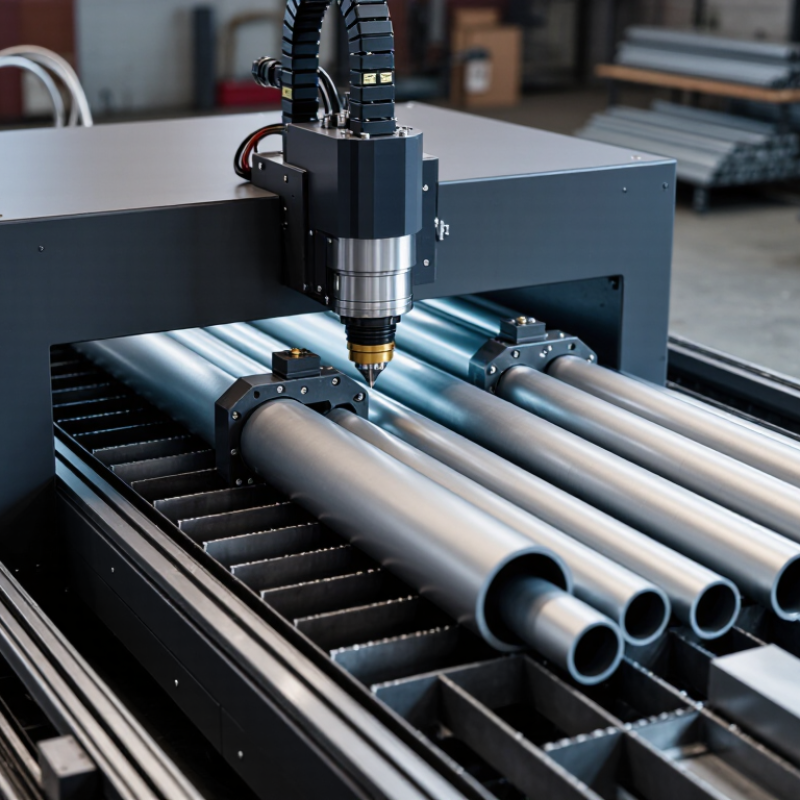
An industrial fiber laser pipe cutter shapes round, square, and rectangular metal tubes with a focused beam of light. The beam heats a narrow line until the material melts, while assist gas clears the cut. A chuck rotates and feeds the tube, and the cutting head follows programmed paths. Picture a steel tube turning steadily as a tiny bright point traces a branch opening.
The U.S. Department of Energy’s industrial laser guidance puts typical fiber-laser wall-plug efficiency around 30–40%, compared with roughly 10–15% for CO₂ lasers. These are general ranges, not guarantees; power settings, maintenance, and operating cycles affect real energy use. A CNC controller coordinates tube rotation, feed, focus, and cut speed. Sensors can help track uneven stock, but they do not replace careful setup. Even a slight misalignment can leave a rough edge.
Tips: Match chuck capacity to the tube’s diameter and weight. Check focus and assist-gas pressure on a test cut. Small checks matter. Record cut settings for each material and wall thickness, then verify them when the tube batch changes.
A pipe cutting machine is only as consistent as its core components. The fiber laser source delivers the beam, while the cutting head focuses it onto the tube wall. Clean optics and stable cooling help maintain reliable output during long shifts. Small details matter.
A capacitive height sensor tracks the pipe surface as it turns, helping keep the nozzle at a controlled distance. Servo-driven chucks and rotary axes hold round or square stock and coordinate its movement with the cutting path. The CNC system manages speed, pierce points, and cut sequences. Assist gas clears molten material from the kerf; extraction removes smoke near the cutting zone. Safety interlocks and enclosed work areas also support predictable operation.
Technical specifications deserve a close look, but they do not tell the whole story. Chuck alignment, tube straightness, and setup quality can affect the finished edge.
Not always.
A machine may cut thin-wall samples cleanly yet need careful tuning for thicker sections or reflective surfaces. Operators should check repeatability across different tube sizes, inspect cut edges, and record settings that work. Cooling capacity and routine lens inspection are easy to overlook, though both can influence uptime. Real shop conditions are messier than a brochure suggests.
Industrial fiber laser pipe cutters can process carbon steel, stainless steel, and aluminum; some configurations also cut copper or brass. Reflective metals need suitable power, optics, and process settings. Round, square, and rectangular tubes are common, while oval, channel, and angle profiles require compatible chucking and cutting software. Fit matters.
The usable diameter, side length, wall thickness, and tube length depend on the machine’s chuck and support system. A 25 mm stainless tube and a 150 mm carbon-steel section do not demand the same setup. Ask for the full cutting range, including minimum diameter and maximum wall thickness for each material. “It cuts tube” is not enough detail.
Industry data helps explain the wider application. World Steel Association’s World Steel in Figures 2024 reports about 1.89 billion tonnes of crude steel production in 2023. Grand View Research estimated the global fiber laser market at USD 6.56 billion in 2023, projecting 11.1% annual growth through 2030.
These figures describe broad markets, not any machine’s capacity. A practical check is to test the actual alloy, profile, and wall thickness; specifications can look clear, yet edge quality may vary.
China’s industrial pipe-cutting lines serve construction, agricultural machinery, vehicle exhaust, and process-piping manufacturers. The scale is substantial: Worldsteel reported that China produced 1,019.1 million tonnes of crude steel in 2023, about 54% of global output. This figure does not measure pipe demand, but it signals the depth of the domestic metalworking supply chain.
Machine configuration should follow the actual tube mix. A rotary chuck and tailstock handle round, square, and rectangular sections; automatic loading helps when long bundles arrive in repeated batches. For thicker walls or frequent bevel cuts, buyers may need greater laser capacity and a tilting cutting head. Thin-wall furniture tubes need a different setup. Fit matters. Diameter range, chuck grip, and remnant length affect usable yield, not just cutting speed.
Automation is increasingly relevant. The International Federation of Robotics reported 276,288 industrial robots installed in China in 2023, representing 51% of global installations. That wider factory trend supports linking pipe cutters with loaders, conveyors, and production scheduling systems. Yet integration is not always smooth. A poorly matched unloading rack can slow a fast cutter, and setup time is easy to underestimate. Buyers should test their real tube sizes and material batches before fixing a configuration.
Selecting an industrial fiber laser pipe cutting machine starts with the material and work mix. Check the pipe diameter range, wall thickness, profile types, and expected shift volume. Fit matters. A machine sized only for today’s busiest job may sit idle on routine orders. Confirm that the chuck can hold the work securely and that loading equipment suits the available floor space.
During operation, operators should verify the cutting program, support points, and assist-gas settings before a new job. A short test cut can reveal burrs or poor edge quality before a full batch is processed. Watch how long pipes behave as they extend beyond the supports; vibration may affect accuracy. Keep the cutting area clear, and follow the equipment maker’s safety procedures. Small habits count.
Maintenance should follow the machine’s documented schedule, not just a drop in cut quality. Inspect lenses and protective windows for contamination, and check nozzles for damage or residue. Clean rails and remove metal dust using approved methods. Record alarms, consumable changes, and cut results so recurring faults are easier to trace. A checklist helps, though rushed shifts can still leave boxes unticked; review it periodically and adjust it to actual working conditions.
Typical nominal wavelengths: fiber lasers are approximately 1.07 μm, CO₂ lasers 10.6 μm, and Nd:YAG lasers 1.064 μm. Fiber laser wavelength can support efficient metal processing, but cutting results depend on material, thickness, power, assist gas, and machine setup. Confirm specifications and test settings for the actual pipe and machine.
A fiber laser source creates the beam, and the cutting head focuses it on the tube. Servo-driven chucks, rotary axes, sensors, and CNC controls coordinate cutting. Clean optics and stable cooling matter.
Common materials include carbon steel, stainless steel, and aluminum. Some configurations can process copper or brass with suitable settings. Round, square, and rectangular tubes are typical; other profiles need compatible tooling and software.
Confirm its minimum diameter, maximum diameter, wall thickness, and tube length for each material. Chuck and support capacity affect the usable range. Ask about your exact alloy and profile.
Yes. Reflective surfaces may require suitable laser power, optics, and process settings. Test the actual material rather than relying only on a specification sheet.
Chuck alignment, tube straightness, and setup can change the finished edge. Vibration from a long, unsupported pipe may reduce accuracy. Real shop conditions can be uneven.
Verify the cutting program, support points, and assist-gas settings. A short test cut can reveal burrs before a full batch begins. Check how the pipe moves beyond its supports.
Follow the documented schedule. Inspect lenses, protective windows, and nozzles for contamination or damage. Clean rails and remove metal dust using approved methods.
Record alarms, consumable changes, and cut results. A checklist helps, but rushed shifts may leave items unchecked. Review it against actual working conditions.
An Industrial Fiber Laser Pipe Cutting Machine uses a focused laser beam to cut, shape, and drill pipe with high accuracy and minimal material waste. Its main systems include the fiber laser source, cutting head, motion controls, chuck or clamping assembly, and software that coordinates cutting paths. Depending on its configuration, the machine can process round, square, rectangular, and other profiles in materials such as carbon steel, stainless steel, and aluminum, across a range of pipe dimensions and wall thicknesses.
In China, these machines serve industries including construction, transportation, machinery, and furniture manufacturing. Available configurations may vary in loading automation, cutting capacity, and level of integration with production lines. Choosing a suitable machine involves matching its capabilities to the materials, shapes, volumes, and tolerances required. Operators should follow safe procedures, use appropriate cutting settings, and keep optics, clamps, and moving components clean and properly maintained to support consistent performance and service life.

+91-79-26840551 / 52 / 53
Domestic: +91 7575 009 654 · Export: +91 7043 505 091
[email protected]
International: [email protected]
Plot No.3, Road No.1, Kathwada GIDC, Kathwada, SP Ring Road, Ahmedabad 382430, Gujarat, India